Phuck yr little J-Edgar spam-game, too, bozostein. Yr a human reject, a ham-fisted, talentless, ineloquent, literal-minded male-shrew: as you prove more convincingly with each yip and yap. Scottie the LIT. Poodle! Roll over n play MORT, Scottie the LIT. Poodle!Almost beautiful in its trollilicious perfection and that's before the real madness sets in.
Wednesday, May 10, 2006
Ourania!
There's a highly enjoyable, even thrilling, trolling orgy over on John & Belle have a Blog (as John Holbo says "Keep scrolling. Further. Further. Ah, there") that descends to the sort of linguistic flights that are generally only found in Finnegan's Wake. Try this for size:

Albert Memorial
 Another glorious day in Belfast. Though this picture was taken at the Albert Memorial in Hyde Park on an even more glorious day!
Tuesday, May 09, 2006
Spot the Ball
 I was in London at the end of last week and (after work) headed for Greenwich to sit in the heat. World Cup fever abounds.
Lazy Journalism, Lazy Blogging
United Irelander has been making hay (and here) recently over this article in the Irish Examiner. According to a sentence at the bottom of the article,
First, I looked in the latest Eurobarometer report (pdf), which was published late last year. Well, the news there is rather positive for supporters of a European Constitution. Strangely enough, in fieldwork last October and November, 60% of Irish respondents expressed support for the idea of a constitution for the EU with only 19% expressing opposition (p. 25). Which is not to say that they support the constitutions as it stands. 22% of European citizens surveyed expressed the opinion that the constitution ought to be re-negotiated with only 13% saying that it ought to be totally dropped (I can't open the Irish country survey for some reason so can't say what it was for the Irish survey).
The Examiner got its line from a more recent (May 2006) and smaller survey (pdf) on 'The Future of Europe,' where the fieldwork was carried out earlier this year. And here's where the Examiner's (and UI's) mistake lies. The 15% figure doesn't refer to support for the constitution. In fact, there's no way that the figure could even be construed as denoting support for the constitution.
The question (p. 154) asked in the survey is 'which two of the following would you consider to be most helpful if anything, for the future of Europe?' Respondents were given six specific options (a common language, well defined external borders for the EU, the introduction of the Euro in all EU countries, comparable living standards, a common army, a common constitution) with the choice of putting in one's own answer, saying nothing would help the future of Europe, or saying that one doesn't know.
Apparently 15% of Irish respondents (according to the discussion from p. 37-9) named a European constitution either as their first or second choice. They were more likely - get this UI - to name the introduction of the Euro across the Union as the thing that would be most helpful.
So there you go, a total mangling of the statistics by the Examiner and United Irelander. For the Examiner it reads just like a piece of lazy misreading. I suppose UI can claim to be the innocent victim of the Examiner's report, but he should recognise that there is, as always, nothing like reading something for yourself.
Since French and Dutch rejection of the Treaty, support [in Ireland] has collapsed to just 15% - it once stood at 78% with Irish voters.Or, as UI has it,
The figures contained in the latest Eurobaromoter survey show that support for the EU Constitution now stands at just 15% - it once stood at 78% with Irish voters.I've been a bit confused by this: such huge drops don't tend to happen. So, instead of doing what UI did - ie taking the report at face value - I went to look at the stats to try and find out what the Examiner is on about.
First, I looked in the latest Eurobarometer report (pdf), which was published late last year. Well, the news there is rather positive for supporters of a European Constitution. Strangely enough, in fieldwork last October and November, 60% of Irish respondents expressed support for the idea of a constitution for the EU with only 19% expressing opposition (p. 25). Which is not to say that they support the constitutions as it stands. 22% of European citizens surveyed expressed the opinion that the constitution ought to be re-negotiated with only 13% saying that it ought to be totally dropped (I can't open the Irish country survey for some reason so can't say what it was for the Irish survey).
The Examiner got its line from a more recent (May 2006) and smaller survey (pdf) on 'The Future of Europe,' where the fieldwork was carried out earlier this year. And here's where the Examiner's (and UI's) mistake lies. The 15% figure doesn't refer to support for the constitution. In fact, there's no way that the figure could even be construed as denoting support for the constitution.
The question (p. 154) asked in the survey is 'which two of the following would you consider to be most helpful if anything, for the future of Europe?' Respondents were given six specific options (a common language, well defined external borders for the EU, the introduction of the Euro in all EU countries, comparable living standards, a common army, a common constitution) with the choice of putting in one's own answer, saying nothing would help the future of Europe, or saying that one doesn't know.
Apparently 15% of Irish respondents (according to the discussion from p. 37-9) named a European constitution either as their first or second choice. They were more likely - get this UI - to name the introduction of the Euro across the Union as the thing that would be most helpful.
So there you go, a total mangling of the statistics by the Examiner and United Irelander. For the Examiner it reads just like a piece of lazy misreading. I suppose UI can claim to be the innocent victim of the Examiner's report, but he should recognise that there is, as always, nothing like reading something for yourself.
Tuesday, May 02, 2006
Trolleys and Roadmaps
Via Crooked Timber, I see that the BBC has posed a number of 'philosophy 101' thought experiments, where you can vote on what you would do when faced with a moral dilemma (presumably they've been reading this book).
One of the more controversial thought experiments is contained in Judith Thompson's 1971 essay 'A Defense of Abortion,' where she introduces the following thought experiment:
This argument has had a number of detractors in the academy, but her important contribution to the debate is that she separates rights from interests (ie., you may have profound interests but that might not translate into a right) and the abortion debate from the 'what constitutes a person' debate.
Anyway, the BBC's essay is fun, but - as I said before - I have a problem with the idea of philosophy being approached like this.
Voting on these issues - forcing the binary yes/no decision - detracts from the really interesting thing about imaginary dilemmas. Simply opting for one conclusion or other is not the point of these hypotheticals. Why the answer is difficult and what that says about our moral thoughts is the important thing. That you arrived at your destination is far less intersting than the map you used.
One of the more controversial thought experiments is contained in Judith Thompson's 1971 essay 'A Defense of Abortion,' where she introduces the following thought experiment:
You wake up in the morning and find yourself back to back in bed with an unconscious violinist. A famous unconscious violinist. He has been found to have a fatal kidney ailment, and the Society of Music Lovers has canvassed all the available medical records and found that you alone have the right blood type to help. They have therefore kidnapped you, and last night the violinist's circulatory system was plugged into yours, so that your kidneys can be used to extract poisons from his blood as well as your own. The director of the hospital now tells you, "Look, we're sorry the Society of Music Lovers did this to you—we would never have permitted it if we had known. But still, they did it, and the violinist is now plugged into you. To unplug you would be to kill him. But never mind, it's only for nine months. By then he will have recovered from his ailment, and can safely be unplugged from you." Is it morally incumbent on you to accede to this situation?Essentially, Thompson argues that, though you would be very nice to accede to the situation, you're under no obligation to do so. By analogy, if you find yourself pregnant you're under no obligation to maintain the pregnancy to term.
This argument has had a number of detractors in the academy, but her important contribution to the debate is that she separates rights from interests (ie., you may have profound interests but that might not translate into a right) and the abortion debate from the 'what constitutes a person' debate.
Anyway, the BBC's essay is fun, but - as I said before - I have a problem with the idea of philosophy being approached like this.
Voting on these issues - forcing the binary yes/no decision - detracts from the really interesting thing about imaginary dilemmas. Simply opting for one conclusion or other is not the point of these hypotheticals. Why the answer is difficult and what that says about our moral thoughts is the important thing. That you arrived at your destination is far less intersting than the map you used.
Monday, May 01, 2006
Sunday, April 30, 2006
Signed
Just flicking through, well, Flickr and I came across this, by Lorissa of the spectacular Apparently Nothing at All photoblog. It's the only time when making a dog's dinner of a photograph is a good thing...
Saturday, April 29, 2006
More Questions on Deporting Irish Citizens
Following on from yesterday's post, I asked a colleague in the Law School here about this issue. He suggested that the answer might lie in the idea that no right to abode is absolute. Theoretically, British citizens could be denied that right too. The problem is that since, under international agreements, a state can't render a person stateless. So the UK can't restart its 'send the convicts down under' policy. But, if this is the answer, it's not entirely satisfactory. If 'references in any Act of Parliament, other enactment or instrument whatsoever, whether passed or made before or after the passing of this Act, to foreigners, aliens, foreign countries...shall be construed' as if Ireland is not a foreign country, then how can practice be different for UK and Irish citizens?
Moreover, this raises some interesting questions about here? Northern Ireland works under the Good Friday Agreement treaty, but nonetheless a few questions are worth asking:
1. Does an Irish citizen deported from GB have a right to reside in Northern Ireland?
2. Does a Northern Ireland judge have a right to deport an Irish citizen to the Republic (even if they are actually from Northern Ireland?)?
3. What is the legal status of the deportations (that do happen) of people from GB to Northern Ireland? Is it the same as deportation to the Republic or different?
Answers on a postcard or in a comment box please!!!
Moreover, this raises some interesting questions about here? Northern Ireland works under the Good Friday Agreement treaty, but nonetheless a few questions are worth asking:
1. Does an Irish citizen deported from GB have a right to reside in Northern Ireland?
2. Does a Northern Ireland judge have a right to deport an Irish citizen to the Republic (even if they are actually from Northern Ireland?)?
3. What is the legal status of the deportations (that do happen) of people from GB to Northern Ireland? Is it the same as deportation to the Republic or different?
Answers on a postcard or in a comment box please!!!
Friday, April 28, 2006
Can Irish citizens be deported from the UK?
If you live in Ireland or the UK you're sure to have seen all the furore over foreign prisoners who were not deported at the end of their sentences. It's my understanding that foreigners are not automatically deported, but that - at least in part - the deportations happen on the recommendation of the judge at the person's trial. But are those orders necessarily legal in the case of Irish citizens? I don't think so.
The plurality of the prisoners came from either Jamaica or Nigeria (figures here) presumably largely involved in drug-running. But 50 of the prisoners were Irish. This is interesting. I haven't been able to google a case, but I know that, very often, when British people come before Irish courts, they are booted out of the country. And this obviously happens in the other direction too. But is it legal?
Well, I'm not sure. A Common Travel Area between Ireland and the UK, in place since the 1920s, ostensibly removes immigration control from between the two islands. In other words, free movement exists (in practice at least). As Lord Filkin said in the Lords (in reply to a question by Lord Kilkooney),
Moreover, I'm not so sure that those special circumstances can be upheld in law.
The status of Irish people in Britain is unclear. According to an article published by Bernard Ryan in 2001 in the Modern Law Review,1
Moreover, as Ryan notes, under the 1949 Ireland act, "'the Republic of Ireland is not a foreign country for the purposes of any law in force in any part of the United Kingdom' and 'references in any Act of Parliament, other enactment or instrument whatsoever, whether passed or made before or after the passing of this Act, to foreigners, aliens, foreign countries...shall be construed accordingly.'" I don't know how this is supposed to sit with the idea that there are special conditions under which the Irish right of abode in the UK can be removed.
So we're left with a bizarre situation. First, removing Irish people from the UK is probably illegal. Second, it's unenforceable. Third, it's happening. How strange.
1. I have a copy of Ryan's article, so give me a shout if you want it, replacing [*at*] with '@'.
2. Which in part explains the Constitutional Amendment to the constitution, adopted in 2004, removing the automatic right to Irish citizenship from the children of non-national parents.
The plurality of the prisoners came from either Jamaica or Nigeria (figures here) presumably largely involved in drug-running. But 50 of the prisoners were Irish. This is interesting. I haven't been able to google a case, but I know that, very often, when British people come before Irish courts, they are booted out of the country. And this obviously happens in the other direction too. But is it legal?
Well, I'm not sure. A Common Travel Area between Ireland and the UK, in place since the 1920s, ostensibly removes immigration control from between the two islands. In other words, free movement exists (in practice at least). As Lord Filkin said in the Lords (in reply to a question by Lord Kilkooney),
The objective of the common travel area is that all the territories should be treated as a single unit for the purpose of travel within the area. A person's arrival in the United Kingdom from within the common travel area is not, therefore, subject to control except under very specific circumstances as outlined in the Immigration Act 1971 and the Control of Entry through the Republic of Ireland Order 1972...The specific circumstances include
persons who are subject to directions given by the Secretary of State for their exclusion from the United Kingdom on the ground that their exclusion is conducive to the public good.I assume these are the grounds under which deportations take place. But I doubt they can be effective. After all, there is no formal procedure for passport control between the UK and Ireland (though the ROI has instituted some limited controls in recent years).
Moreover, I'm not so sure that those special circumstances can be upheld in law.
The status of Irish people in Britain is unclear. According to an article published by Bernard Ryan in 2001 in the Modern Law Review,1
Even after the treaty of Amsterdam [where Ireland and the UK gained a derogation from the Schengen Agreement], it remains the case that the content of [the Common Travel Area] 'arrangements' have not been publicised by the two states.According to Ryan, the agreement, motivated by the status of Northern Ireland, the need for Irish labour and the sheer difficulty in enforcing a border, started off essentially with free movement on condition that the Irish remained under the British border control umbrella. With the exception of WW2, this freedom based on a 'shared' immigration policy continues.2
Moreover, as Ryan notes, under the 1949 Ireland act, "'the Republic of Ireland is not a foreign country for the purposes of any law in force in any part of the United Kingdom' and 'references in any Act of Parliament, other enactment or instrument whatsoever, whether passed or made before or after the passing of this Act, to foreigners, aliens, foreign countries...shall be construed accordingly.'" I don't know how this is supposed to sit with the idea that there are special conditions under which the Irish right of abode in the UK can be removed.
So we're left with a bizarre situation. First, removing Irish people from the UK is probably illegal. Second, it's unenforceable. Third, it's happening. How strange.
1. I have a copy of Ryan's article, so give me a shout if you want it, replacing [*at*] with '@'.
2. Which in part explains the Constitutional Amendment to the constitution, adopted in 2004, removing the automatic right to Irish citizenship from the children of non-national parents.
Thursday, April 27, 2006
Google Fight
Via In Fact, Ah's Rugby Musings, I came across Google Fight. Looks like I have a little way to go, though everyone gets beaten in turn.
Wednesday, April 26, 2006
Jacobs
Following on from my post on Robert Moses, Mel has some interesting links by way of an obituary for the prominent urban ecologist Jane Jacobs.
Tuesday, April 25, 2006
Hmmm Haughey?
Er, is it just me or do you get a link to Charlie Haughey's obituaries when you type 'charles j Haughey' into the search function on the Irish Times's front page? Sadly even logged in you don't get to read the article, but methinks someone's confusing their public and private access rights in IT central!
Update Thanks to Dick O'Brien, I've put the link right.
Update 2 It seems the Irish Times have fixed their issue. I've kept a souvenir jpeg but it would be cruel (and in breach of copyright methinks) to publish it!
Update Thanks to Dick O'Brien, I've put the link right.
Update 2 It seems the Irish Times have fixed their issue. I've kept a souvenir jpeg but it would be cruel (and in breach of copyright methinks) to publish it!
Monday, April 24, 2006
Hall on Start the Week
Radio 4's Start the Week began yesterday morning with a discussion of Waiting for Godot. Andrew Marr was speaking to Peter Hall, who was the first to stage the English translation of Godot. He was followed, by the way by, by a discussion of Orson Wells. On a scale of 1 to 10, how ashamed ought I to be that I've never seen Citizen Kane?
Friday, April 21, 2006
Guarding Snips
I know! It is just downright silly, but how often do you get a picture of a heavy policing contingent outside a wig shop?
Redz Quare

1916 and Republicanism
Thursday, April 20, 2006
Coffee's Clarendon Lectures
I see that John Coffee will be presenting the Clarendon Lectures in Oxford's Saïd Business School (next door to the railway station) on the 24th to the 26th of May. He'll be speaking (his current book is billed as the Clarendon lectures) on why the oversight and transparency systems (the 'gatekeepers' as he puts it) in the corporate world failed, thus leading to the collapse of Enron and other firms. Pity I won't be across the water for that. Coffee's a very engaging writer and I'm sure will be enormously rewarding in person.
Podcasts Etc
Wednesday, April 19, 2006
Armies are Not a Source of Pride
One of the more bizarre images from the First World War – in hindsight at least – was occasioned by the start of the battle around what was to become the Ypres salient in 1914. Apparently, the people of the town all gathered on top of Ypres’ medieval walls in order to view the excitement. The town museum has photographs of the people, all presumably expecting a visual confirmation of the romantic stories of warfare that were the belligerent currency of the time. Of course, as we know now, what was to come was utterly beyond the imaginings of the people on the wall.
Mechanical, mass warfare would, within a few weeks, literally demolish the town, scatter the survivors of the bombardment and turn the region into a spectacle of graveyards.
I wonder how the people on the Ypres’ impotent, obsolete, comical ramparts would have felt if they had had an inkling of what the coming war would mean for the soldiers – buttons polished – who had marched through the town's gates to meet the German advance. Or what it would mean for them as the military machine enveloped them in its embrace.
But they could only see the world through the romantic sentiments about military life that were current at the time. Militaries were a source of national pride because they presented not just a vision of strength but because they presented a distillation of the national virtues: courage, loyalty, self-sacrifice and the like.
As Sunday’s festivities in Dublin suggest, people don’t seem yet to learn that armies are not sources of pride and grand spectacles only serve to obscure their true function in society.
There are two special elements in the story told about the Irish army. First, the army is the legitimate heir of Óglaigh na hÉireann. Ministers haven’t taken this line solely because they have made the foolish decision to compete with the Provos on their own ground. They also see the Irish army as the guarantor of freedom for the nation and as such as more than a facet of statehood. Second, people have spoken about the army’s proud record in United Nations peace-keeping operations, for instance in Katanga or more recently in East Timor and Sierra Leone.
It may well be that on some level these claims are true. But, if so, they are true not because of some special characteristics of the army as a corporate entity. They are true because Irish governments and society chose to employ the army as a tool in the name of some laudable aims. As such, pride in the army seems misplaced, except insofar as the army acts as a symbol of national virtues (I don’t actually think nations can have virtues, but that’s an argument for another day – my point is only that seeing things this way would be more coherent than simply having pride in the army per se).
So where does this leave the army? Well, it leaves the army where it belongs: as a tool of state power, and certainly not necessarily as a tool of state virtue. Given what they are designed to do – no matter how laudable the political aims behind their actions – one ought to regard armies as at best a sad necessity of statehood. Morally speaking, we’d be better off without them. Even if, pragmatically speaking, they are necessary, that doesn’t make them a good thing. It’s hard to see, in that case, armies are any more worth celebrating than rat-catchers.
That’s not to say that individual soldiers don’t display some of the virtues that we attach to armies. Soldiers might well be courageous, loyal and the like. But that only makes those soldiers admirable individuals. Their virtues can’t be transferred to the army itself.
Sunday’s parade was wrong because it celebrated the most unfortunate side of statehood: the necessity for states to reserve the use of force. Like the citizens of Ypres, we mistake the romance attached to armies for virtue.
Mechanical, mass warfare would, within a few weeks, literally demolish the town, scatter the survivors of the bombardment and turn the region into a spectacle of graveyards.
I wonder how the people on the Ypres’ impotent, obsolete, comical ramparts would have felt if they had had an inkling of what the coming war would mean for the soldiers – buttons polished – who had marched through the town's gates to meet the German advance. Or what it would mean for them as the military machine enveloped them in its embrace.
But they could only see the world through the romantic sentiments about military life that were current at the time. Militaries were a source of national pride because they presented not just a vision of strength but because they presented a distillation of the national virtues: courage, loyalty, self-sacrifice and the like.
As Sunday’s festivities in Dublin suggest, people don’t seem yet to learn that armies are not sources of pride and grand spectacles only serve to obscure their true function in society.
There are two special elements in the story told about the Irish army. First, the army is the legitimate heir of Óglaigh na hÉireann. Ministers haven’t taken this line solely because they have made the foolish decision to compete with the Provos on their own ground. They also see the Irish army as the guarantor of freedom for the nation and as such as more than a facet of statehood. Second, people have spoken about the army’s proud record in United Nations peace-keeping operations, for instance in Katanga or more recently in East Timor and Sierra Leone.
It may well be that on some level these claims are true. But, if so, they are true not because of some special characteristics of the army as a corporate entity. They are true because Irish governments and society chose to employ the army as a tool in the name of some laudable aims. As such, pride in the army seems misplaced, except insofar as the army acts as a symbol of national virtues (I don’t actually think nations can have virtues, but that’s an argument for another day – my point is only that seeing things this way would be more coherent than simply having pride in the army per se).
So where does this leave the army? Well, it leaves the army where it belongs: as a tool of state power, and certainly not necessarily as a tool of state virtue. Given what they are designed to do – no matter how laudable the political aims behind their actions – one ought to regard armies as at best a sad necessity of statehood. Morally speaking, we’d be better off without them. Even if, pragmatically speaking, they are necessary, that doesn’t make them a good thing. It’s hard to see, in that case, armies are any more worth celebrating than rat-catchers.
That’s not to say that individual soldiers don’t display some of the virtues that we attach to armies. Soldiers might well be courageous, loyal and the like. But that only makes those soldiers admirable individuals. Their virtues can’t be transferred to the army itself.
Sunday’s parade was wrong because it celebrated the most unfortunate side of statehood: the necessity for states to reserve the use of force. Like the citizens of Ypres, we mistake the romance attached to armies for virtue.
Thursday, April 13, 2006
Rising? When?
Here's a challenge. Without looking it up, do you know precisely what date the Easter Rising took place on in 1916? I got caught out on this a few days ago. Looked it up since (here)!
Friday, March 31, 2006
Bob the Builder
One of the unspoken factors in reflection on government is the acquisition, use and abuse of power. Of course, we do find ourselves turning to Foucauldian-style critiques of ‘Power,’ or in analyses of how, at some macro level, certain classes maintain their privileges to the disadvantage of others, or how will (of the people, of the leader) is transformed into action through a sequence of formal procedures. What we tend not to notice is the manner in which individuals can and do pursue power, ruthlessly and obsessively and then hold on to it against all forces. Blind as we are to how such people circumvent formal technologies of government, we tend not to see the full story of how societies, states and cities are shaped.
I’ve just finished Robert Caro’s mammoth (over half- million word) study of power in practice: his biography of Robert Moses, The Power Broker.
Chances are that, if you’re from my side of the Atlantic, you never heard of Bob Moses. Chances are, also, that if you’ve ever been to New York, you enjoyed and suffered the consequences of his forty-year stranglehold over the city’s landscape and infrastructure. Moses was New York State’s Parks Commissioner and the chair of a number of NYC’s public authorities, most notably the Triborough Bridge Authority and the Housing Commission from the 1920s until the 1960s. Starting off as Parks Commissioner he constructed some of the most beautiful city and state parks in the US, starting on Long Island, as well as the ‘parkways’ that provided the new car-owning society with access to those parks. Through Triborough he built the bridges (and partly the tunnels) and highways that determined the shape of New York’s sprawl out from Manhattan.
Notionally, all Moses’s work was done at the behest of the various mayors and governors under whose administrations he worked. But Moses had, early on, used his brilliant drafting of laws to remove himself from their influence. The legislation that created the great parks he built, for example, included clauses giving him absolute authority within the parks.
It was in Triborough that his real genius was invested though. Since, after years of Tammany Hall’s misrule, NYC was for all intents and purposes bankrupt, money for Moses public works was (formally) raised through bond issues – essentially through mortgages with the city’s banks. Moses devised the bond contracts to give Triborough absolute sovereignty in the city, making the organisation untouchable and making the organisation’s chair unimpeachable. And given that contracts are guaranteed under the US constitution, once they were issued nothing could be done.
But this is the real stroke of genius and the tragedy of Moses’s reign. By law, Authorities were established in order to do a specific thing (build a bridge for example) and, once the bonds were paid off (say through a toll on the bridge) they had to go out of existence and the infrastructure would be handed back to the city. Moses figured that, instead of simply paying off the bonds, he could simply use part of the revenue from one piece of infrastructure as collatoral on new bonds to build new pieces of infrastructure. So long as he kept doing this, his authority could never be shut down (since it would always have constitutionally-guaranteed debts to service).
But this all relied on Moses being able to continuously build. If he stopped he’d lose his empire. As with most empires, the only way to keep going was to keep moving.
In order to pull this off, he built up a coalition of (sometimes very dodgy) bankers who wanted the huge profits from the bonds, trade unions who wanted continuous well-resourced work, and politicians who wanted to be seen to be getting-things-done and who wanted their palms well-greased. Using the acclaim he had received from building the great parks, he scrupulously maintained his public image so that elected officials who got in his way, say as he sought to demolish a neighbourhood and displace its occupants for a highway, could at best not get a public hearing and would at worst be subject to scurrilous and vicious public attacks.
It also helped Moses obscure the fact that, in having the city build supposedly marginal elements in his projects (though in fact they were often far from marginal), Moses was diverting almost all city funding from education health and from his primary competitor – public transport.
In essence, Moses used politics (and a reputation for being above politics) to engage in a more than three decade frenzied building programme that gave New York most of its bridges major highways. Which was all very well except that the programme was obviously not, after a while, designed with the needs of commuters or with ease of movement in mind. It was designed around Moses lust for power and around his own ego and whims.
It rapidly became obvious that the building of highways was only leading to gridlock and that, as new highways were built, new cars were coming onto the roads. Not only was each new road blocked, but all the old roads would get busier as the new ones were built. But Moses was blind to this. He refused to fund public transport or even to leave space for public transport around his roads. This was partly because of a deep antipathy he had for people, mainly black and Puerto Rican, who depended on mass transit. Indeed, by displacing funding from public transport to cars, he was actively chasing anyone who had a choice away from trains and buses and funnelling them instead through the traffic jams and toll booths on his bridges.
Moses use of power often seemed petty and mean. His parkways, for example, were the only route to his parks. But he built all the bridges over the parkways 11 feet high. Inadvertant or not, because of this, buses (that require a minimum clearance of 14 feet) could not use the parkways and (until the building of the Long Island Expressway) could not get to the parks. Moses guaranteed that his parks, such as that at Jones Beach, would not be available to the poor.
Moses's reasoning was sometimes utterly obscure, such as when he destroyed an old mixed community in Fairmont in the Bronx by running the Cross-Bronx expressway straight through it (directly demolishing 1500 homes) instead of taking an alternative route that was no less convenient to drivers but would have led to the demolition of 6 homes.
Two things eventually started Moses downfall, though so late on that Moses was in his 70s. The first had to do with his grasping on to the chair of the city’s slum-clearance programme. Moses was not at all interested in slum clearance but had grabbed the programme because it presented an opportunity to spread largesse to his various clients. But the corruption in the programme was so spectacular that it actually created larger slums on the sites of the old ones. The scandal that arose from the corruption of the programme provided the first openly visible stain on Moses’s public image.
The second part in Moses downfall was an attempt to build a car park in Central Park in order to serve the Tavern on the Green, then run at an enormous profit by one of Moses acolytes. This was utterly insignificant compared to Moses’s activities in the Bronx and in Haarlem, but this time Moses took on the moneyed classes of the city and refused to back down. The spat turned the media against him and he never regained his reputation.
Eventually Moses was sidelined by Nelson Rockefeller who combined political power as governor and, crucially, as a member of the family that owned Chase Manhattan, was able to face down the banks in whose hands Moses’s bonds lay.
Although the narrative that Caro constructs is a tale of events, the important story is the manner in which, through ambition, patronage, pr and bullying, Moses managed to construct and maintain a personal empire for so long. He was the ultimate boss – a supreme manipulator of all the interests that matter in politics. At the same time, though, his motivations were never financial: Moses manoeuvres had a purpose.
Getting Things Done might have ultimately become an end in itself but this was largely accompanied by a serious, if often stubbornly bull-headed and misguided, will to improve the city for the city's people. Theory finds it very difficult to capture the sort of phenomenon represented by Moses and, as a result, our understanding of society is much much poorer.
I’ve just finished Robert Caro’s mammoth (over half- million word) study of power in practice: his biography of Robert Moses, The Power Broker.
Chances are that, if you’re from my side of the Atlantic, you never heard of Bob Moses. Chances are, also, that if you’ve ever been to New York, you enjoyed and suffered the consequences of his forty-year stranglehold over the city’s landscape and infrastructure. Moses was New York State’s Parks Commissioner and the chair of a number of NYC’s public authorities, most notably the Triborough Bridge Authority and the Housing Commission from the 1920s until the 1960s. Starting off as Parks Commissioner he constructed some of the most beautiful city and state parks in the US, starting on Long Island, as well as the ‘parkways’ that provided the new car-owning society with access to those parks. Through Triborough he built the bridges (and partly the tunnels) and highways that determined the shape of New York’s sprawl out from Manhattan.
Notionally, all Moses’s work was done at the behest of the various mayors and governors under whose administrations he worked. But Moses had, early on, used his brilliant drafting of laws to remove himself from their influence. The legislation that created the great parks he built, for example, included clauses giving him absolute authority within the parks.
It was in Triborough that his real genius was invested though. Since, after years of Tammany Hall’s misrule, NYC was for all intents and purposes bankrupt, money for Moses public works was (formally) raised through bond issues – essentially through mortgages with the city’s banks. Moses devised the bond contracts to give Triborough absolute sovereignty in the city, making the organisation untouchable and making the organisation’s chair unimpeachable. And given that contracts are guaranteed under the US constitution, once they were issued nothing could be done.
But this is the real stroke of genius and the tragedy of Moses’s reign. By law, Authorities were established in order to do a specific thing (build a bridge for example) and, once the bonds were paid off (say through a toll on the bridge) they had to go out of existence and the infrastructure would be handed back to the city. Moses figured that, instead of simply paying off the bonds, he could simply use part of the revenue from one piece of infrastructure as collatoral on new bonds to build new pieces of infrastructure. So long as he kept doing this, his authority could never be shut down (since it would always have constitutionally-guaranteed debts to service).
But this all relied on Moses being able to continuously build. If he stopped he’d lose his empire. As with most empires, the only way to keep going was to keep moving.
In order to pull this off, he built up a coalition of (sometimes very dodgy) bankers who wanted the huge profits from the bonds, trade unions who wanted continuous well-resourced work, and politicians who wanted to be seen to be getting-things-done and who wanted their palms well-greased. Using the acclaim he had received from building the great parks, he scrupulously maintained his public image so that elected officials who got in his way, say as he sought to demolish a neighbourhood and displace its occupants for a highway, could at best not get a public hearing and would at worst be subject to scurrilous and vicious public attacks.
It also helped Moses obscure the fact that, in having the city build supposedly marginal elements in his projects (though in fact they were often far from marginal), Moses was diverting almost all city funding from education health and from his primary competitor – public transport.
In essence, Moses used politics (and a reputation for being above politics) to engage in a more than three decade frenzied building programme that gave New York most of its bridges major highways. Which was all very well except that the programme was obviously not, after a while, designed with the needs of commuters or with ease of movement in mind. It was designed around Moses lust for power and around his own ego and whims.
It rapidly became obvious that the building of highways was only leading to gridlock and that, as new highways were built, new cars were coming onto the roads. Not only was each new road blocked, but all the old roads would get busier as the new ones were built. But Moses was blind to this. He refused to fund public transport or even to leave space for public transport around his roads. This was partly because of a deep antipathy he had for people, mainly black and Puerto Rican, who depended on mass transit. Indeed, by displacing funding from public transport to cars, he was actively chasing anyone who had a choice away from trains and buses and funnelling them instead through the traffic jams and toll booths on his bridges.
Moses use of power often seemed petty and mean. His parkways, for example, were the only route to his parks. But he built all the bridges over the parkways 11 feet high. Inadvertant or not, because of this, buses (that require a minimum clearance of 14 feet) could not use the parkways and (until the building of the Long Island Expressway) could not get to the parks. Moses guaranteed that his parks, such as that at Jones Beach, would not be available to the poor.
Moses's reasoning was sometimes utterly obscure, such as when he destroyed an old mixed community in Fairmont in the Bronx by running the Cross-Bronx expressway straight through it (directly demolishing 1500 homes) instead of taking an alternative route that was no less convenient to drivers but would have led to the demolition of 6 homes.
Two things eventually started Moses downfall, though so late on that Moses was in his 70s. The first had to do with his grasping on to the chair of the city’s slum-clearance programme. Moses was not at all interested in slum clearance but had grabbed the programme because it presented an opportunity to spread largesse to his various clients. But the corruption in the programme was so spectacular that it actually created larger slums on the sites of the old ones. The scandal that arose from the corruption of the programme provided the first openly visible stain on Moses’s public image.
The second part in Moses downfall was an attempt to build a car park in Central Park in order to serve the Tavern on the Green, then run at an enormous profit by one of Moses acolytes. This was utterly insignificant compared to Moses’s activities in the Bronx and in Haarlem, but this time Moses took on the moneyed classes of the city and refused to back down. The spat turned the media against him and he never regained his reputation.
Eventually Moses was sidelined by Nelson Rockefeller who combined political power as governor and, crucially, as a member of the family that owned Chase Manhattan, was able to face down the banks in whose hands Moses’s bonds lay.
Although the narrative that Caro constructs is a tale of events, the important story is the manner in which, through ambition, patronage, pr and bullying, Moses managed to construct and maintain a personal empire for so long. He was the ultimate boss – a supreme manipulator of all the interests that matter in politics. At the same time, though, his motivations were never financial: Moses manoeuvres had a purpose.
Getting Things Done might have ultimately become an end in itself but this was largely accompanied by a serious, if often stubbornly bull-headed and misguided, will to improve the city for the city's people. Theory finds it very difficult to capture the sort of phenomenon represented by Moses and, as a result, our understanding of society is much much poorer.
Men Shall Know Commonwealth
Just listening to Leonard Cohen's sublime new album, Dear Heather, as I work. One of the best albums I've heard in a while. The quasi-prose-poem Villanelle For Our Time is my favourite, methinks. Well worth the outlay.
Thursday, March 30, 2006
Best Front Page Photo

The FT is not renowned for humourous coverage, but the photo (from Getty Images) on their front page today is excellent, if somewhat subtle.
According to the FT, it's a picture of Neil Aspinall, head of The Beatles' Apple Corp, as he 'arrives at the High Court where the record label yesterday renewed its long-running legal battle with Apple Computer. Apple Corp, owned by band members and their estates, is accusing the US company of breaching a trademark agreement by "selling music" through its online iTunes music store, which uses the Apple name and logo. It is the third time Apple Corp has sued the computer group over use of the Apple name.'
Haughey 'Seriously Ill'
Apparently he's been taken to the Mater Hospital in Dublin. RTÉ news coverage here.
Tuesday, March 28, 2006
Turkey in the EU
There was an interesting debate from Istanbul on the BBC World Service last Sunday, prompted by debates in Turkey over modernity, driven in part by the question of membership of the EU.
It's a surprise to hear some of the comments and questions that are being seriously considered, notably on the role of the military, on minorities and on religion. Then again, it doesn't take much recollection of the sorts of debates that took place in Ireland over Irish membership of the Union to reveal how European Ireland has become. I assume the same will happen to Turkey and, to my mind, that's no bad thing.
It's a surprise to hear some of the comments and questions that are being seriously considered, notably on the role of the military, on minorities and on religion. Then again, it doesn't take much recollection of the sorts of debates that took place in Ireland over Irish membership of the Union to reveal how European Ireland has become. I assume the same will happen to Turkey and, to my mind, that's no bad thing.
Monday, March 27, 2006
Joint Sovereignty in the Here and Now
So, having met up in Brussels, Bertie and Tony will come over to Belfast for a last ditch attempt at getting the whole thing rolling. I’m not so sure they’re going to be successful, at least according to the standard they’ve set themselves: the stable running of an assembly with an executive.
Isn’t it time, though that we recognised the more fundamental fact about Northern Ireland politics? That, functioning Assembly or not, joint sovereignty exists in the here and now.
People – especially across these islands – tend to think sovereignty is a simple question of which flag flies over their public buildings. Sovereignty seems to mean total freedom from outside interference.
But sovereignty is never absolute. Legislative and political decisions cannot be made free from the influence of other institutions or factors. Indeed, we’re not even free from the influence of our own past decisions. Ireland, for example, is not totally sovereign because, through referenda, the Irish people handed a small part of their sovereignty over to the European Union.
In any case, and this is just as analogously important to a discussion of joint sovereignty over Northern Ireland, even if Ireland wasn’t a member of the EU, it wouldn’t be sovereign in a full or absolute sense. Ministers would still be trapped in their decisions by their calculations over the vicissitudes of international markets and Ireland’s place in them. Sovereignty implies autonomy and that is just impossible to have in full.
On the formal level, the Good Friday Agreement, and the Anglo-Irish Treaty before that, saw Westminster handing some portion of sovereignty over to the Irish state. Just as when it joined the EU, the UN and the IMF. So, on a formal level, the implementation of the GFA treaty in Northern Ireland is a matter for the consideration of both the Dublin and London governments.
Moreover, informally, no British government will move in Northern Ireland without some degree of collaboration with Dublin. We shouldn’t mistake a much-vaunted Parliamentary sovereignty either for freedom of action or for a wish for freedom of action.
But let’s not lose the run of ourselves. Joint sovereignty doesn’t mean that decisions are made on some sort of 50:50 basis – that authority is split down the middle. Ireland’s influence over Northern Ireland is probably more akin to Germany’s influence over French policies through the EU. But, on major decisions, Northern Ireland is not best thought of as being solely at the mercy of Westminster. Whether or not there’s an assembly makes no difference to this.
This fact, as it stands, represents better news for Unionists than they may think and worse news for Nationalists than they may think.
Given the Irish state’s general credo that a little of something for free is better than having it all at a price (viz NATO) I suspect that they’re rather happy with the status quo. They are seen to be a strong voice for nationalist interests in London and (given how much higher Northern Ireland is on the Irish agenda than it is on the British one) they can set the Northern Ireland agenda without actually paying much for the place. This is probably deemed much preferable to the hallowed United Ireland. And, given that, the Nationalist’s best friend may very well not share their ultimate goals.
Unionists for their part should actually loudly welcome the Irish role. Instead of harping on about British sovereignty they ought see the Irish role as being a price worth paying for making Northern Ireland habitable for Nationalists in perpetuity. They should think of it as renting out one field so they can keep the farm. Indeed, given the fact that, ultimately, the Irish state is on their side (i.e., it’s interests lie in Northern Ireland remaining in the UK) Unionism should welcome joint sovereignty as a symbol that, on the big questions, they’ve won.
Isn’t it time, though that we recognised the more fundamental fact about Northern Ireland politics? That, functioning Assembly or not, joint sovereignty exists in the here and now.
People – especially across these islands – tend to think sovereignty is a simple question of which flag flies over their public buildings. Sovereignty seems to mean total freedom from outside interference.
But sovereignty is never absolute. Legislative and political decisions cannot be made free from the influence of other institutions or factors. Indeed, we’re not even free from the influence of our own past decisions. Ireland, for example, is not totally sovereign because, through referenda, the Irish people handed a small part of their sovereignty over to the European Union.
In any case, and this is just as analogously important to a discussion of joint sovereignty over Northern Ireland, even if Ireland wasn’t a member of the EU, it wouldn’t be sovereign in a full or absolute sense. Ministers would still be trapped in their decisions by their calculations over the vicissitudes of international markets and Ireland’s place in them. Sovereignty implies autonomy and that is just impossible to have in full.
On the formal level, the Good Friday Agreement, and the Anglo-Irish Treaty before that, saw Westminster handing some portion of sovereignty over to the Irish state. Just as when it joined the EU, the UN and the IMF. So, on a formal level, the implementation of the GFA treaty in Northern Ireland is a matter for the consideration of both the Dublin and London governments.
Moreover, informally, no British government will move in Northern Ireland without some degree of collaboration with Dublin. We shouldn’t mistake a much-vaunted Parliamentary sovereignty either for freedom of action or for a wish for freedom of action.
But let’s not lose the run of ourselves. Joint sovereignty doesn’t mean that decisions are made on some sort of 50:50 basis – that authority is split down the middle. Ireland’s influence over Northern Ireland is probably more akin to Germany’s influence over French policies through the EU. But, on major decisions, Northern Ireland is not best thought of as being solely at the mercy of Westminster. Whether or not there’s an assembly makes no difference to this.
This fact, as it stands, represents better news for Unionists than they may think and worse news for Nationalists than they may think.
Given the Irish state’s general credo that a little of something for free is better than having it all at a price (viz NATO) I suspect that they’re rather happy with the status quo. They are seen to be a strong voice for nationalist interests in London and (given how much higher Northern Ireland is on the Irish agenda than it is on the British one) they can set the Northern Ireland agenda without actually paying much for the place. This is probably deemed much preferable to the hallowed United Ireland. And, given that, the Nationalist’s best friend may very well not share their ultimate goals.
Unionists for their part should actually loudly welcome the Irish role. Instead of harping on about British sovereignty they ought see the Irish role as being a price worth paying for making Northern Ireland habitable for Nationalists in perpetuity. They should think of it as renting out one field so they can keep the farm. Indeed, given the fact that, ultimately, the Irish state is on their side (i.e., it’s interests lie in Northern Ireland remaining in the UK) Unionism should welcome joint sovereignty as a symbol that, on the big questions, they’ve won.
Sunday, March 26, 2006
Role of the Media
I'm sure there's no real need for me to link to posts on Slugger O'Toole. If you're here you've most likely been there. But there's a fascinating debate on the role of the media in society (sparked by Michael McDowell) in the comments section of this post.
Saturday, March 25, 2006
Schmap
I've just taken a look at the new Schmap city guide: pretty impressive.* This is the sort of Web 2.0 thing that will be hitting us over the next few years I suppose. It takes various bits of freeware or creative commons stuff (photos etc) and sticks it all in something between an e-book, a photo slideshow and Google Earth.
It's still in beta and I think there are a few flaws both fiddling (I think the font is too small) and more substantial. Primarily, there's no option for downloading new guides from within the player. I couldn't figure out whether I should store files I download myself or awkwardly copy it into the Schmap folder in the administrative bit of my docs and settings. After all, that's where the original city file I downloaded with the player resides. Also, newly irritatingly evangelical Linux afficianado that I am, pity it's Windows only.
But don't let that stop you having a glance. Shmap is well worth the look and I think will be a formidable addition to online work distractions as the Summer rolls in!
* Full disclosure: they have shortlisted one of my photos off Flickr for the Dublin Guide, which is how I came across it. As their blog mentions reveal, that shortlisting process is an astute marketing ploy! I should also mention that it's not entirely clear that use of the photos is compatible with the Creative Commons licences under which pictures are used. Like others, I suspect it's not. Which is why they get you to accept another licence agreement.
It's still in beta and I think there are a few flaws both fiddling (I think the font is too small) and more substantial. Primarily, there's no option for downloading new guides from within the player. I couldn't figure out whether I should store files I download myself or awkwardly copy it into the Schmap folder in the administrative bit of my docs and settings. After all, that's where the original city file I downloaded with the player resides. Also, newly irritatingly evangelical Linux afficianado that I am, pity it's Windows only.
But don't let that stop you having a glance. Shmap is well worth the look and I think will be a formidable addition to online work distractions as the Summer rolls in!
* Full disclosure: they have shortlisted one of my photos off Flickr for the Dublin Guide, which is how I came across it. As their blog mentions reveal, that shortlisting process is an astute marketing ploy! I should also mention that it's not entirely clear that use of the photos is compatible with the Creative Commons licences under which pictures are used. Like others, I suspect it's not. Which is why they get you to accept another licence agreement.
Friday, March 24, 2006
As they say in Dublin...
...or at least, as they said when I was in the first bloom of youth:
SNARED!
This has to be the most entertaining bug report I've ever read! Courtesy of The Register.
SNARED!
This has to be the most entertaining bug report I've ever read! Courtesy of The Register.
Georgetown podcasts
Since Intelligent Securocrat Pixies poisoned my water this week1 thus leaving me less able for typing-style research, I took the opportunity to listen to a few of the excellent podcasts from Georgetown Law School's site. Of those that I listened to, two stand out for me.
The first is a witty and interesting interview with US Supreme Court Justice Stephen Breyer2, who tries to give an insight into how the USSC works, and his take on various legal/political questions doing the rounds, including the concept of originalism in constitutional interpretation.
The second is a largely calm and well informed debate on Civil Defence v Civil Liberties.3 It's generally a good debate, with only one person really engaging in hyperbole. The phone-tapping affair and the ongoing detention of people in Guantanamo is addressed. Very interesting.
1I deny the unproven 'tummy bug' theory being spread about by evil Darwinist Protestant atheists.
2I can only get the audio (mp3) to work.
3And again...
The first is a witty and interesting interview with US Supreme Court Justice Stephen Breyer2, who tries to give an insight into how the USSC works, and his take on various legal/political questions doing the rounds, including the concept of originalism in constitutional interpretation.
The second is a largely calm and well informed debate on Civil Defence v Civil Liberties.3 It's generally a good debate, with only one person really engaging in hyperbole. The phone-tapping affair and the ongoing detention of people in Guantanamo is addressed. Very interesting.
1I deny the unproven 'tummy bug' theory being spread about by evil Darwinist Protestant atheists.
2I can only get the audio (mp3) to work.
3And again...
Monday, March 20, 2006
Modernism in the V&A
I'll be working in London for a day in May and must make time to pop over to Kensington to see the modernism exhibition in the V&A. It looks like it's going to be fascinating. Good preview in Saturday's FT here.
Something Tells Me It's All Happening At...
 ...the zoo. But not quite at Belfast Zoo. We headed up there on Saturday and - thanks to the cold cold wind - all the animals seemed wisely to have hidden themselves away. We saw some penguins, some seals (which were presumably enjoying some proper weather for a change), a couple of antelopes and a peacock. And that's it. Oh, and some guys sweeping an empty elephant compound.
An zoo without creatures provides confirmation, if it was needed, that Belfast is straight out of Father Ted. Which is to say, bonkers but marvellous! I want to go back next weekend and marvel at the place!
Wednesday, March 15, 2006
From the Curragh
 This is another picture of the Grand Canal: the water coming in under this bridge is drained off the Curragh, thus presumably preventing it being a lot damper than it is. Oh the joys of Victorian engineering!
Monday, March 13, 2006
O'Connor Criticises the Republicans
The Guardian and NPR report a speech where Justice Sandra Day O'Connor 'blasted' the US Republicans for their attempts to undermine the judiciary in the States. There's a webcast about O'Connor over on the Georgetown site. I haven't been able to find her speech so won't comment on the substance but it's always a surprise to see judges let fly, even when they do so with some justification.
Off the Books
Via a friend in Dublin, this article comes to light, outlining some of the pre-Act of Union laws that are about removed from the Irish statute books. Apart from the legislation that would make Andrew McCann shiver with joy (like the law from 1360 "against people associating with the Irish, using their language, or sending children to be nursed among them" or from 1366 preventing the English marrying the Irish) there's this one that I think many of you (especially given the video of the recent Blog Awards) would be interested in:
Among those laws about to be consigned to history is the Tippling Act 1735, which prohibits a publican from pursuing a customer for money owed for any drink given on credit.Update: I knew it was a familiar story: George Burns posted on it over on Slugger ten days ago. Us academics are so ahead of the curve!
Friday, March 10, 2006
Icy Spring
 I took this beside the Grand Canal near Robertstown in Kildare. The light is partly digital I admit, but the ice on the canal certainly isn't.
Wednesday, March 08, 2006
What's Wrong with Wrong Beliefs?
A post Frank put up a few months ago came to mind last week. Frank made a very cogent argument that intuitionism was a pretty shoddy approach to moral reasoning.
In a totally oblique way, this came to mind when I was listening to Thought for the Day a while back (unusual that I was paying attention at all, but there you go). A person called Anne Atkins made a very good point. Speaking about David Irving’s incarceration in Austria for denying the Holocaust, Atkins took the interesting position that although we might want to restrict people’s rights to express opinions (approving remarks about the Holocaust for example) it seems perverse to imprison them for simply saying things that are not true – statements of fact, she seemed to say, are by their nature innocuous.1 All you need to do in the face of wrong beliefs, she claims, is to stick someone on the Today Programme to counter the wrong statement (echoing Mill’s pretty strategic justification for free speech). Of course, this assumes that Irving was honestly mistaken in denying the holocaust (which is his line) and not cynically manipulating the available facts and records in order to sustain a political position.
But I wonder how we say that a mistaken belief is in and of itself innocuous – I suspect that we actually do disapprove of all sorts of false beliefs and actively regard them as dangerous and bad. Are all mistaken beliefs really on a par? Is racism or holocaust denial (both of which rely on beliefs about facts) really equivalent to, say, holding relatively innocuous mistaken beliefs, say about astrology or homoeopathy?
In fact, a quick skip around the blogosphere suggests that the general intuition is that mistaken, though sincere, beliefs are very often regarded as moral failings. We tend to think of people who hold beliefs profoundly different to our own as being more than simply fools. They're bad fools. But I can't actually think of any way we could argue for the immorality of mistaken beliefs (I'd love to stand corrected on this).
We might be able to argue against the normative judgements that invariably accompany statements of belief. Holocaust deniers, it seems, tend to be anti-Semites (or give comfort to anti-Semites) and people who believe in racial difference tend also to actively discriminate (or, again, give succour to active bigots). So maybe sometime we condemn holocaust deniers not because of their beliefs but because we suspect that they are actively discriminatory. Or we condemn pacifists because they give succour to haters-of-our-freedom etc. But that’s different to providing reasons to condemn simple holders of belief. How are passive, silent racists bad?
We could say that people who make statements of fact have duties towards the truth and towards standards of evidence. So some supposed statements of fact rely upon spectacular failures to consider evidence with any objectivity or critical eye. But we’re all guilty of this to some degree – it’s practically impossible – outside stringent experimental conditions – to assess evidence without prior intuitions getting into the mix. Even if we could identify the point when our conclusions, rather than falling within the range of reasonable difference (where the evidence could really go either way or where positions rely more upon how we prioritise competing norms), reflect our exclusion of crucial facts for fear that they would disrupt our positions, we would still not condemn the belief, but the methods by which the person arrived at that belief.
Similarly, we all tend to hide from interpretations or facts that disrupt our world views. We read newspapers that reassure rather than challenge us. We respond dismissively to unwelcome reports and even take great pleasure in shooting the various messengers that bring ignored facts to our attention. But, again, this sort of moral failure is about the information-gathering that leads to mistaken beliefs, not about the holding of those beliefs.
Maybe this is the issue. We tend to condemn people for not facing up to whatever facts we prioritise (sometimes with more grounds than others). But I’m damned if I know how a line could be formulated to demarcate innocuous and immoral false beliefs. And I suppose this is the crucial importance of intuitionism. It is not a claim that there is no space for reasoning in moral thinking. It is a claim that reasoning is not the only or total route to conclusions about morality. Moral thinking tends to carry within its sphere motives of compassion and sympathy (and hatred) which are not entirely open to articulation (though emotions they may, as Martha Nussbaum pointed out, be no less intelligent). It also tends to be cumulative – a specific moral thought reflects, in part, a personal history of moral thoughts, thus making the manner in which we reach conclusions remarkably obscure.
1David Vance also makes a similar point when he insists that holocaust denial is not a crime. Of course (pedantic old me) he doesn’t mean that holocaust denial isn’t actually a crime: it patently is in the countries he mentions. What I suppose he means is that there can be nothing inherently criminal about belief, even though it might be very wrong indeed to hold that belief. Similar points are made by United Irelander, Maca and myriad others.
In a totally oblique way, this came to mind when I was listening to Thought for the Day a while back (unusual that I was paying attention at all, but there you go). A person called Anne Atkins made a very good point. Speaking about David Irving’s incarceration in Austria for denying the Holocaust, Atkins took the interesting position that although we might want to restrict people’s rights to express opinions (approving remarks about the Holocaust for example) it seems perverse to imprison them for simply saying things that are not true – statements of fact, she seemed to say, are by their nature innocuous.1 All you need to do in the face of wrong beliefs, she claims, is to stick someone on the Today Programme to counter the wrong statement (echoing Mill’s pretty strategic justification for free speech). Of course, this assumes that Irving was honestly mistaken in denying the holocaust (which is his line) and not cynically manipulating the available facts and records in order to sustain a political position.
But I wonder how we say that a mistaken belief is in and of itself innocuous – I suspect that we actually do disapprove of all sorts of false beliefs and actively regard them as dangerous and bad. Are all mistaken beliefs really on a par? Is racism or holocaust denial (both of which rely on beliefs about facts) really equivalent to, say, holding relatively innocuous mistaken beliefs, say about astrology or homoeopathy?
In fact, a quick skip around the blogosphere suggests that the general intuition is that mistaken, though sincere, beliefs are very often regarded as moral failings. We tend to think of people who hold beliefs profoundly different to our own as being more than simply fools. They're bad fools. But I can't actually think of any way we could argue for the immorality of mistaken beliefs (I'd love to stand corrected on this).
We might be able to argue against the normative judgements that invariably accompany statements of belief. Holocaust deniers, it seems, tend to be anti-Semites (or give comfort to anti-Semites) and people who believe in racial difference tend also to actively discriminate (or, again, give succour to active bigots). So maybe sometime we condemn holocaust deniers not because of their beliefs but because we suspect that they are actively discriminatory. Or we condemn pacifists because they give succour to haters-of-our-freedom etc. But that’s different to providing reasons to condemn simple holders of belief. How are passive, silent racists bad?
We could say that people who make statements of fact have duties towards the truth and towards standards of evidence. So some supposed statements of fact rely upon spectacular failures to consider evidence with any objectivity or critical eye. But we’re all guilty of this to some degree – it’s practically impossible – outside stringent experimental conditions – to assess evidence without prior intuitions getting into the mix. Even if we could identify the point when our conclusions, rather than falling within the range of reasonable difference (where the evidence could really go either way or where positions rely more upon how we prioritise competing norms), reflect our exclusion of crucial facts for fear that they would disrupt our positions, we would still not condemn the belief, but the methods by which the person arrived at that belief.
Similarly, we all tend to hide from interpretations or facts that disrupt our world views. We read newspapers that reassure rather than challenge us. We respond dismissively to unwelcome reports and even take great pleasure in shooting the various messengers that bring ignored facts to our attention. But, again, this sort of moral failure is about the information-gathering that leads to mistaken beliefs, not about the holding of those beliefs.
Maybe this is the issue. We tend to condemn people for not facing up to whatever facts we prioritise (sometimes with more grounds than others). But I’m damned if I know how a line could be formulated to demarcate innocuous and immoral false beliefs. And I suppose this is the crucial importance of intuitionism. It is not a claim that there is no space for reasoning in moral thinking. It is a claim that reasoning is not the only or total route to conclusions about morality. Moral thinking tends to carry within its sphere motives of compassion and sympathy (and hatred) which are not entirely open to articulation (though emotions they may, as Martha Nussbaum pointed out, be no less intelligent). It also tends to be cumulative – a specific moral thought reflects, in part, a personal history of moral thoughts, thus making the manner in which we reach conclusions remarkably obscure.
1David Vance also makes a similar point when he insists that holocaust denial is not a crime. Of course (pedantic old me) he doesn’t mean that holocaust denial isn’t actually a crime: it patently is in the countries he mentions. What I suppose he means is that there can be nothing inherently criminal about belief, even though it might be very wrong indeed to hold that belief. Similar points are made by United Irelander, Maca and myriad others.
Friday, March 03, 2006
Prisoner Economy
I was stuck on a piece of work the other day so started reading a piece that Mel had sent me quite a while ago: R.A. Radford’s ‘The Economic Organisation of a P.O.W. Camp,’1 published in Economica in November 1945. It’s fascinating stuff. Radford’s basic point is that the P.O.W. Camp represented, in miniature, the economic society and provided a good case for some simple theories of currency and pricing etc. He found that transit camps were not particularly stable markets, with lots of people coming and going, so that profits were to be made from a dearth of information as to what various commodities from Red Cross Parcels and the like were worth. ‘Stories circulated of a padre,’ for example
Around D-day the camp economy was apparently so buoyant that the officers opened a very successful camp restaurant, with profits being ploughed back into the society through the bribing of guards for essential materials etc. This was on top of a long-established not-for-profit camp shop which had stabilised prices somewhat. Eventually, a paper currency, interchangeable with cigarettes (sort of a gold standard) was introduced, acceptable at the restaurant and the shop.
This is all fascinating stuff. I wonder, though, whether these dynamics would be replicated today. Radford’s story is interesting in and of itself, but also because of its emphasis on price-stabilisation and on the trend towards central control of supply and demand (i.e. the shop and the restaurant). That strikes me as being evidence, of a sort, that the psychology of the market is relatively culturally specific.
I suspect that your average economist in this day and age would decide that the most rational method for satisfying supply and demand would be some sort of auction, with people directly bidding for commodities. I suspect also that you’d have had some sort of futures market working away (which did exist in embryonic form in the camps), with people buying future supplies at future prices.
The one thing I don’t think would exist is the investment bank: I suspect this works in the real economy in part because we don’t see or don’t understand how banks make enough to cover their costs, make a profit and pay us interest. If we did, either we’d conclude that a collaborative enterprise like a bank was more beneficial for us or that we could do the necessary investments ourselves. In that camp, of course, the second thing is far easier, given the small, intimate, size of the economy. So the banker would simply not be trusted to bring us extraordinary returns. I also don't suppose that this sort of thing can develop without officers overseeing the standards of exchange (acting as a state essentially) and without some degree of freedom of movement among the prisoners (so that's Gitmo out).
1By the way, if you can’t access the article, just send me an email at ciaran_o_kelly[at]yahoo[dot]co[dot]uk (with the [at] replaced by ‘@’ and the [dot] replaced by ‘.’) and I’ll send it on to you.
who started off round the camp with a tin of cheese and five cigarettes and returned to his bed with a complete [Red Cross] parcel in addition to his original cheese and cigarettes; the market was not yet perfect.In more settled camps, the market grew too complicated for simple barter:
Within a week or two, as the volume of trade grew, rough scales of exchange values came into existence. Sikhs, who had at first exchanged tinned beef for practically any other foodstuff, began to insist on jam and margarine. It was realised that a tin of jam was worth ½ lb. of margarine plus something else; that a cigarette issue was worth several chocolate issues, and a tin of diced carrots was worth practically nothing.Over time, cigarettes became the currency for the camp.
The cigarette became the standard of value. In the permanent camp people started wandering through the bungalows calling their offers - ‘cheese for seven’ (cigarettes) – and the hours after [Red Cross] parcel issue were Bedlam. The inconveniences of this system soon led to its replacement by an Exchange and Mart notice board in every bungalow, where under the headings ‘name,’ ‘room number,’ ‘wanted,’ and ‘offered’ sales and wants were advertised. When a deal went through it was crossed off the board. The public and semi-permanent records of transactions led to cigarette prices being well known and thus tending to equality throughout the camp, although there were some opportunities for an astute trader to make a profit from arbitrage. With this development everyone, including non-smokers was willing to sell for cigarettes, using them to buy at another time and place. Cigarettes became the normal currency, although of course barter was never extinguished.Radford goes on to describe the development of a pure market with prices fixed by supply-and-demand. Admittedly, being free of almost all labour, it was a strange market, but it was one nevertheless. He was particularly interested in cigarettes as currency, arguing that they ‘performed all the functions of a metallic currency as a unit of account.’ Indeed, the camps even experienced inflation linked to money-supply, namely to the rise and fall in the availability of cigarettes as Red Cross parcels came. An influx of hungry new prisoners would increase the price of food. And an air raid would lead to much of the currency being smoked, thus provoking deflation.
Around D-day the camp economy was apparently so buoyant that the officers opened a very successful camp restaurant, with profits being ploughed back into the society through the bribing of guards for essential materials etc. This was on top of a long-established not-for-profit camp shop which had stabilised prices somewhat. Eventually, a paper currency, interchangeable with cigarettes (sort of a gold standard) was introduced, acceptable at the restaurant and the shop.
This is all fascinating stuff. I wonder, though, whether these dynamics would be replicated today. Radford’s story is interesting in and of itself, but also because of its emphasis on price-stabilisation and on the trend towards central control of supply and demand (i.e. the shop and the restaurant). That strikes me as being evidence, of a sort, that the psychology of the market is relatively culturally specific.
I suspect that your average economist in this day and age would decide that the most rational method for satisfying supply and demand would be some sort of auction, with people directly bidding for commodities. I suspect also that you’d have had some sort of futures market working away (which did exist in embryonic form in the camps), with people buying future supplies at future prices.
The one thing I don’t think would exist is the investment bank: I suspect this works in the real economy in part because we don’t see or don’t understand how banks make enough to cover their costs, make a profit and pay us interest. If we did, either we’d conclude that a collaborative enterprise like a bank was more beneficial for us or that we could do the necessary investments ourselves. In that camp, of course, the second thing is far easier, given the small, intimate, size of the economy. So the banker would simply not be trusted to bring us extraordinary returns. I also don't suppose that this sort of thing can develop without officers overseeing the standards of exchange (acting as a state essentially) and without some degree of freedom of movement among the prisoners (so that's Gitmo out).
1By the way, if you can’t access the article, just send me an email at ciaran_o_kelly[at]yahoo[dot]co[dot]uk (with the [at] replaced by ‘@’ and the [dot] replaced by ‘.’) and I’ll send it on to you.
Wednesday, February 22, 2006
Innovations
The last few months have involved two major technological innovations for me. First, I handed my television over to the brother and told him to use it as he sees fit. I wish I could sit here and tell you that it was Galloway’s appearance on Big Brother that did it for me. I admit I was tempted to sit down and write a letter of apology to Osama Bin Laden (something along the lines of ‘you were right all along. We’re vomitorium hedonists careering around the garlanded emptiness of our lives and we deserve to be dispatched to our maker in bite-sized pieces. Here’s my address to help you bump me up the to-bump-off list. Miaow’).
But I’ve nothing so principled to announce I’m afraid. I’m just sick of watching television. Which is a good thing: I’m a total television addict. I could leave the bloody thing on all day every day and stay up late watching total unremitting shite. I was not entertained and yet I kept on watching. So it was time to give the thing away and do without. I have to say I missed it hugely for the first day or so, but after that it really was easy. I have an excellent digital radio and half a dozen entertaining channels to choose from. I have a mammoth backlog of books to read, both for fun and for work (I’ve just finished Cormac McCarthy’s blistering Border Trilogy and at the moment I’m meandering my way through Caro’s mammoth 1976 biography and character study of Robert Moses, The Power Broker). I have a huge collection of music to listen to. I have enormous amounts of work to do. So armed with myriad ways to stave off the boredom that the TV exacerbates I don’t miss it at all. Good riddance.
In a totally unrelated step, I’ve dumped Windows off my laptop. I know my way around Windows but I’m a little tired of watching its performance falling off within weeks of reformatting or first boot. I’m not too concerned about the viruses that we know about: it’s the slow log-in times pointing to the viruses we don’t know about that worry me. So, I took the opportunity of changing the hard drive on my laptop to load up Linux Ubuntu.
Ubuntu is designed precisely for people like me: the dangerous sort with enough nous to totally wreck a system but not enough to fix it again. The OS is really very impressive so far: it comes bundled with Open Office, which I’m finding a bit more stable than Office XP (and more competent when I crash it) and a huge range of other software. It’s noticeably faster than Windows XP on my machine and far more configurable, which means I can mess to my hearts content. And if I truly screw up I’ll just reinstall: it doesn’t mean sitting online for a day downloading from Microsoft Update. In fact, I can partition the drive such that my personal files are separated from the OS, so reinstalling the system doesn’t mean having to lose all the files and configurations I’ve built up. And it’s all free!
All I’ve needed was access to Google so that I could find what I needed and how to add in the various bits and pieces that I wanted.
Still, I wonder if I can wire up Linux to watch Lost?
But I’ve nothing so principled to announce I’m afraid. I’m just sick of watching television. Which is a good thing: I’m a total television addict. I could leave the bloody thing on all day every day and stay up late watching total unremitting shite. I was not entertained and yet I kept on watching. So it was time to give the thing away and do without. I have to say I missed it hugely for the first day or so, but after that it really was easy. I have an excellent digital radio and half a dozen entertaining channels to choose from. I have a mammoth backlog of books to read, both for fun and for work (I’ve just finished Cormac McCarthy’s blistering Border Trilogy and at the moment I’m meandering my way through Caro’s mammoth 1976 biography and character study of Robert Moses, The Power Broker). I have a huge collection of music to listen to. I have enormous amounts of work to do. So armed with myriad ways to stave off the boredom that the TV exacerbates I don’t miss it at all. Good riddance.
In a totally unrelated step, I’ve dumped Windows off my laptop. I know my way around Windows but I’m a little tired of watching its performance falling off within weeks of reformatting or first boot. I’m not too concerned about the viruses that we know about: it’s the slow log-in times pointing to the viruses we don’t know about that worry me. So, I took the opportunity of changing the hard drive on my laptop to load up Linux Ubuntu.
Ubuntu is designed precisely for people like me: the dangerous sort with enough nous to totally wreck a system but not enough to fix it again. The OS is really very impressive so far: it comes bundled with Open Office, which I’m finding a bit more stable than Office XP (and more competent when I crash it) and a huge range of other software. It’s noticeably faster than Windows XP on my machine and far more configurable, which means I can mess to my hearts content. And if I truly screw up I’ll just reinstall: it doesn’t mean sitting online for a day downloading from Microsoft Update. In fact, I can partition the drive such that my personal files are separated from the OS, so reinstalling the system doesn’t mean having to lose all the files and configurations I’ve built up. And it’s all free!
All I’ve needed was access to Google so that I could find what I needed and how to add in the various bits and pieces that I wanted.
Still, I wonder if I can wire up Linux to watch Lost?
Friday, February 17, 2006
Tour in Ruins
Callalillie has taken a rather strange tour, of 'preserved ruins.' The photos remind me (not entirely accurately) of the lovely, vaguely creepy Horta Museum on Rue Americaine in Brussels (creepy because I've always been vaguely discomfited by walking through people's houses). Still, this tour is certainly on the list for the next trip to NYC.
I must post my musings at some stage on the shift in American culture at the turn of the 19th and 20th Centuries, from emulating European (largely Francophile) aesthetics to being the focus for everyone else's artistic, architectural and musical aesthetics - from Met to Moma, in a way.
I must post my musings at some stage on the shift in American culture at the turn of the 19th and 20th Centuries, from emulating European (largely Francophile) aesthetics to being the focus for everyone else's artistic, architectural and musical aesthetics - from Met to Moma, in a way.
Wednesday, February 15, 2006
Tuesday, February 14, 2006
Crumby Proclamation
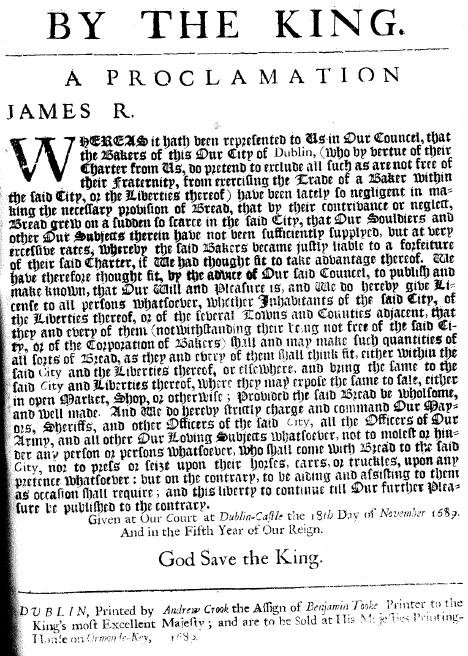 Apropos of absolutely nothing, I asked a friend who has access to such things to email me copy of this 1689 proclamation by King James to the people of Dublin regarding the scarcity of bread in the city. Click on the image to zoom in. I wonder why the bakers weren't keeping the bread supply up? What could have been going on at the time? I can't imagine...
Saturday, February 11, 2006
Wake
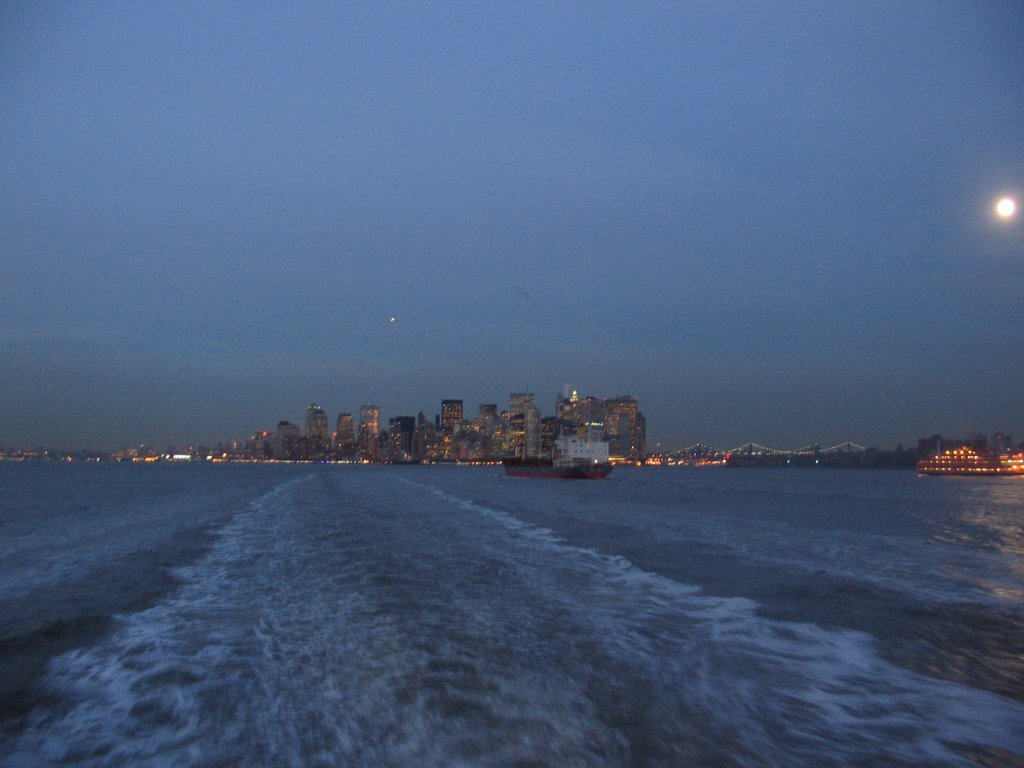 I can't tell you how difficult it is to take long-exposure photographs on a moving ship. Thankfully I avoided accidental blurring on this one by softening the image in an artful manner. I like the result though!
Friday, January 27, 2006
On Libertarianism Doesn't Apply to Children
There's a very interesting post over on Internet Commentator, addressing the question of how libertarianism might or might not apply to children. Frank is hostile to the idea that "children are either property of their parents and implicitly theirs to abuse as they see fit, or free agents who implicitly have the "rights" to spurn school, refuse medical treatment and have sex with dirty old men." Can't argue with that, though I raised the issue of whether and how we can distinguish between a child and an adult. Frank's reply is excellent.
If you've anything to say, say it over there.
If you've anything to say, say it over there.
Wednesday, January 25, 2006
Greenery
 Well, after all that snow, and inspired by Belfast's unseasonably good weather, here's a picture of yellowy-green summery grass. And hills.
In other words, I've nothing to say.
Monday, January 23, 2006
Unphotographable
Via a very very roundabout route, I've just come across the other-worldly, almost meditative Unphotographable - an account of photographs never taken. Very strange idea, stunningly realised.
Friday, January 20, 2006
Cruise Control
This piece of sad news from The Register:
UK TV viewers will not get to see an episode of South Park which shows Nicole Kidman and fellow Scientologist John Travolta attempting to coax a fictional Tom Cruise character out of a closet, with Kidman saying: "Don't you think this has gone on long enough? It's time for you to come out of the closet. You're not fooling anyone."Apparently the Cruise character in the show claims that he isn't in the closet, although he actually is. More on this, plus legal analysis (seriously!) by Julie Hilden over on Findlaw.
Interestingly, the episode itself indicates that its creators know well that they may be defaming Cruise, and they know of his litigious history. The joke disclaimer preceding the episode announces that "All characters and events on this show -- even those based on real persons -- are entirely fictional." At the end of the episode, the Cruise character threatens to bring a suit (not on the gay issue, but in defense of Scientology) "in England" -- which lacks a formal equivalent of the First Amendment. And all the credits at the end use the pseudonyms "John Smith" and "Jane Smith."Hilden doesn't think Cruise would win in the face of a 1st Amendment defence, but it probably won't come to that. The episode will probably just disappear.
Thursday, January 19, 2006
Drottningholm
 Another Sweden picture: I likes this one. Not sure about the framing on the left though.
Tuesday, January 17, 2006
Howzat for plagiarism???
 Courtesy of somebody who mysteriously found me through googling this (I'm not sure if I've even seen this movie), here's an interesting set of pictures. But less interesting than the non-cgi Educating Rita to my curmudgeounly mind!
Heidegger and the Nazis
I was going to start this post with a stamp of irritation with BBC Radio 4 saying what Friday coming's Afternoon Play (Todtnauberg, by John Banville, which might be quite interesting) as presenting an account of a meeting between Paul Celan and Martin Heidegger, "the Nazi Philosopher."
I'm no fan of Heidegger, but, although it might be entirely fair ('cos it's true) that he was a Nazi, it's surely unfair to say that he was "the Nazi Philosopher." As Richard Rorty insists, surely we can separate the man's terrible politics and actions from his work (and our use of that work)?1
But now I'm not so sure of that position: an internet search (oh font of verifiably high-quality wisdom!) brought this long paper to light (with a response here), where Alex Steiner argues that it is quite possible to associate Heidegger's work with his Nazism. I don't know enough to be sure. Is there anyone out there with a helpful opinion?
1 Rorty addresses Heidegger's Nazism in in 'Another Possible World,' which was published in the London Review of Books in 1990. The essay was republished in Philosophy and Social Hope as 'On Heidegger's Nazism.'
I'm no fan of Heidegger, but, although it might be entirely fair ('cos it's true) that he was a Nazi, it's surely unfair to say that he was "the Nazi Philosopher." As Richard Rorty insists, surely we can separate the man's terrible politics and actions from his work (and our use of that work)?1
But now I'm not so sure of that position: an internet search (oh font of verifiably high-quality wisdom!) brought this long paper to light (with a response here), where Alex Steiner argues that it is quite possible to associate Heidegger's work with his Nazism. I don't know enough to be sure. Is there anyone out there with a helpful opinion?
1 Rorty addresses Heidegger's Nazism in in 'Another Possible World,' which was published in the London Review of Books in 1990. The essay was republished in Philosophy and Social Hope as 'On Heidegger's Nazism.'
Is this West West Lothian?
I was interested to listen to Lord Baker talking about the West Lothian question on the Today Programme this morning (the realplayer file is here). I have to say that I'm somewhat sympathetic, on the face of it at least, to the idea that there something amiss when Scottish MPs can vote on some issues that affect English people but that English MPs can't vote on the same issues as they affect the Scots. That said, I think the problem arises from an incoherent devolution strategy for the UK, not from a devolution per se.
Anyway, from a NI-narcissism point of view, I was intrigued (and mildly concerned) to hear Lord Baker proposing that the solution was for the Speaker to ringfence some bills or section of bills as being territorially specific and that, therefore, only MPs from that territory could debate them.
Does this imply that only MPs elected to Northern Ireland constituencies would debate and vote on NI-specific legislation? Surely the Westminster asylum is getting along fine on its own without our particular brand of lunatic taking over...
Anyway, from a NI-narcissism point of view, I was intrigued (and mildly concerned) to hear Lord Baker proposing that the solution was for the Speaker to ringfence some bills or section of bills as being territorially specific and that, therefore, only MPs from that territory could debate them.
Does this imply that only MPs elected to Northern Ireland constituencies would debate and vote on NI-specific legislation? Surely the Westminster asylum is getting along fine on its own without our particular brand of lunatic taking over...
Monday, January 16, 2006
Not Before 2007
To coin the lovely phrase, the EU Constitution hasn't gone away you know. Although it's in hiding in Ireland. As noted on the The Fundamental Principles of the European Constitition blog, Bertie has just said that there won't be any movement on the issue before the next French Presidential election (in 2007) so the constitution won't be addressed in the lifetime of the Dáil. Here's hoping that when they do deal with it they do what the Convention actually intended, which is a basic statement of principles of governance, not a gargantuan attempt to fuse all treaties together.
And maybe, while they're at it, they could come up with a different name...
And maybe, while they're at it, they could come up with a different name...
Friday, January 13, 2006
Thursday, January 12, 2006
AIG-whizz
Well, as a philosopher I tend not to be all that au-fait with things topical, but one perk of my job is that I get to hang around with people who know their stuff. This week the leader of the project that I work for had an article in the Irish Times (subs required, but we have the text from the article up on our site here) outlining the manner in which Dublin became the hub for a major piece of false accounting in the reinsurance industry. According to Justin, this has had a major reputational impact on Ireland as an offshore financial centre
Reinsurance is just what it says on the tin: insurance companies insure their books against huge losses so that they can survive major claims, in the same way that small bookies pass parts of bets on to bigger bookies when they are made. When it's working properly the reinsurer takes a portion of the risk on, for a premium, and pays out if required.
Fraud happens (for example that between American International Group and General Re) when money is supposed to be transferred but, secretly, no risk is transferred (and not much of the money). When this happens the client (equivalent to the small bookie) essentially receives a loan from the reinsurer but sticks the transaction on the books as an asset rather than as a liability (I'm a bit hazy on this, but I think that that's what's going on). So AIG was able to overstate their market value. General re was paid a fee without taking on any risk of having to pay out money.
There's lots more on this in various places, including in the Washington Post, on the Law Professors' Blog, in the Irish Times, and in the Insurance Journal.
But for Ireland it comes down to this: the country is no longer a cheap place for doing business (given the rise in the corporate tax rate), but any advantage it might have in terms of reputation (advanced European democracy and all that), will not be helped by these sorts of events. Whether or not there was regulatory oversight involved (and you should not Justin's quote from Charlie McCreevy on this), it is not good news. And neither is it going to go away.
Reinsurance is just what it says on the tin: insurance companies insure their books against huge losses so that they can survive major claims, in the same way that small bookies pass parts of bets on to bigger bookies when they are made. When it's working properly the reinsurer takes a portion of the risk on, for a premium, and pays out if required.
Fraud happens (for example that between American International Group and General Re) when money is supposed to be transferred but, secretly, no risk is transferred (and not much of the money). When this happens the client (equivalent to the small bookie) essentially receives a loan from the reinsurer but sticks the transaction on the books as an asset rather than as a liability (I'm a bit hazy on this, but I think that that's what's going on). So AIG was able to overstate their market value. General re was paid a fee without taking on any risk of having to pay out money.
There's lots more on this in various places, including in the Washington Post, on the Law Professors' Blog, in the Irish Times, and in the Insurance Journal.
But for Ireland it comes down to this: the country is no longer a cheap place for doing business (given the rise in the corporate tax rate), but any advantage it might have in terms of reputation (advanced European democracy and all that), will not be helped by these sorts of events. Whether or not there was regulatory oversight involved (and you should not Justin's quote from Charlie McCreevy on this), it is not good news. And neither is it going to go away.
Tuesday, January 10, 2006
Treeline
 Back from a lovely, cold, break in Sweden. God - does this mean I have to do some work now???
Saturday, December 24, 2005
Winter Bee
 I was surprised to see a bumble bee in the garden just now, obviously (from the yellow spot on her leg) gathering quite a bit of pollen for a nest. Very strange on Christmas Eve.
Wandering
In my seasonal meanderings around the blogosphere, I suspect that Lex has by far the best picture of the moment. And the BBC's Late Junction, despite the devilish rumours to the contrary, actually has all the best tunes.
Thursday, December 22, 2005
2006 Threats
Great piece on tonight's Channel 4 News: a top 10 list of threats to the UK in 2006. Christmas cheer par excellence... The video can be viewed through the item's page.
Vacation!

Term is over so it's time for rest. Good stuff! After a nightmare journey down to Dublin (mostly my fault) I'm in for a great holiday. I hope you have a good one yourself.
Wednesday, December 21, 2005
Steamy
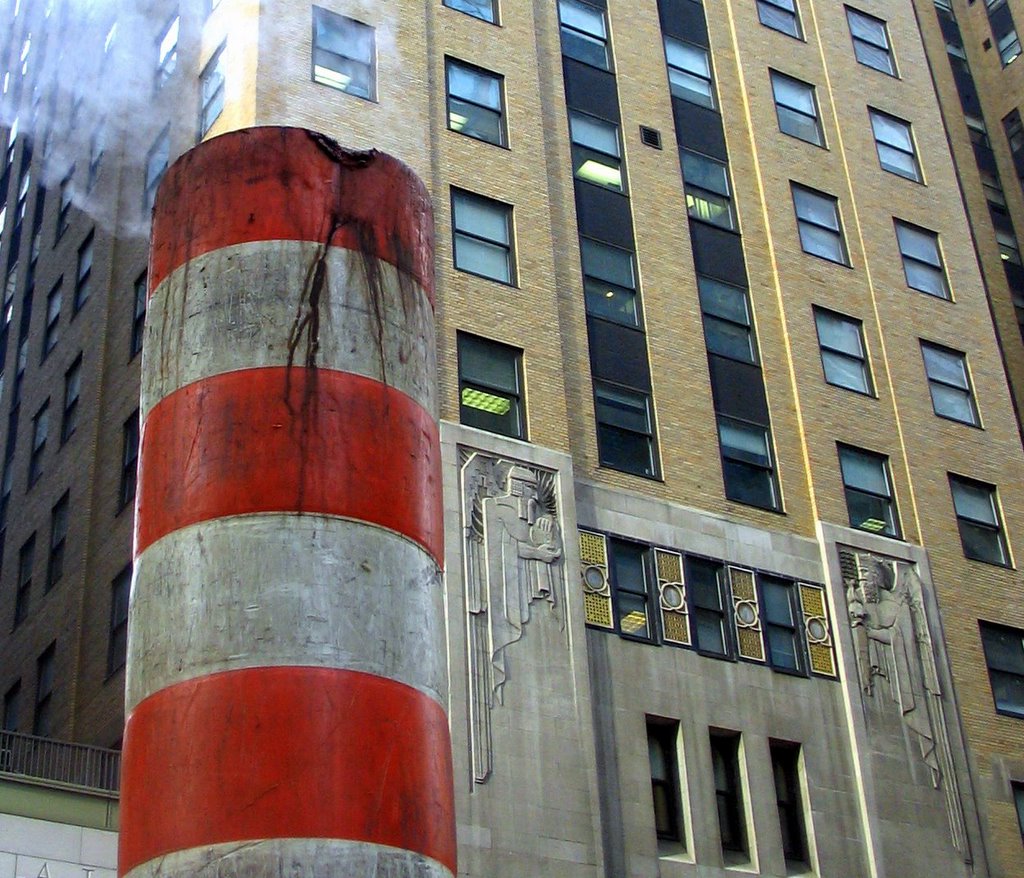
You really can't hang around New York without finding a picture of a red and white thingy with Steam coming out (Assyrian facade optional). The NYC equivalent of a red-haired girl with a donkey.
Tuesday, December 20, 2005
Attitudes towards an (the?) EU Constitution
I can't find the data on the Eurobarometer site, but RTÉ is reporting a slight rise in support for an EU constitution in the latest Eurobarometer, accompanied admittedly by a drop in general support for the EU. Interpreting from very slight data (academic speak for 'guessing'), this suggests a rather normal trend in political thinking: if you don't trust the institution, you'd better get yourself protected by a body of law.
Shutterseek
Via Apparently Nothing, I've just come across a wonderful resource: ShutterSeek. It's a kind of Lifehacker for camera obsessives. Great stuff!
Coasting
 A more pleasant picture today, taken somewhere beyond New Haven on the Boston-New York train: by far the best way to travel between the two cities.
By the way: them there on the horizon are a spectacularly bleak row of houses.
Monday, December 19, 2005
He knows when you are sleeping...
 Not that anybody needs a reminder of the heightened tensions in the American security apparatus, here's a photo of the armed coast guard boat that accompanied the Staten Island Ferry from Manhattan last week. The ferry is the best way to see NYC (especially, as we did, at dusk) and I fully recommend it. But sometimes it's hard not to be put off by the incessant monitoring. This is partly because, instead of being reassuring, it sort of puts everyone on notice that the baddies are out to get you. Maybe that's what it's supposed to do?
By the way, Mel makes some interesting points linking last week's spook-related revelations on both sides of the Atlantic.
In Our Time on Hobbes
Thanks to Stefan, I've been pointed out to a very good piece on Thomas Hobbes in Radio 4's In Our Time: a great programme reviewing both Hobbes's life and his philosophy.
Long Way Home
As well all know, the news in the UK over the last number of years has often involved the ramifications of poverty and exclusion in the North of England. Geographical and demographic factors certainly disadvantage the North compared to the relatively rich and prosperous South.
Well, I have the solution.
Why not compel half the trans-Atlantic flights into London to land in Leeds-Bradford Airport before they fly on to Heathrow or wherever? Just force them to land there. Perhaps create an enterprise zone around Leeds-Bradford thus creating a few jobs in the area.
Of course, viewed from a national perspective the benefits of such a policy might not be totally obvious. After all, any jobs created in the North would likely be offset by job-losses in the South as travellers and the like diverted their trans-Atlantic trips to Paris and Frankfurt. Moreover, the effect of the policy on the North of England’s economy would be pretty limited – limited in fact to the people who worked in or around the airport. And it goes without saying that travellers to London would be hugely pissed off as they wasted time sitting in Leeds-Bradford and wasted money subsidising the tickets of the, say, 10% of passengers who actually disembarked in Leeds-Bradford.
Still, at least the slightly smaller pork(barrel) pie would have more evenly spaced slices.
I’ve arrived back in Belfast from the States after flying into Dublin (via the Shannon stopover).
Well, I have the solution.
Why not compel half the trans-Atlantic flights into London to land in Leeds-Bradford Airport before they fly on to Heathrow or wherever? Just force them to land there. Perhaps create an enterprise zone around Leeds-Bradford thus creating a few jobs in the area.
Of course, viewed from a national perspective the benefits of such a policy might not be totally obvious. After all, any jobs created in the North would likely be offset by job-losses in the South as travellers and the like diverted their trans-Atlantic trips to Paris and Frankfurt. Moreover, the effect of the policy on the North of England’s economy would be pretty limited – limited in fact to the people who worked in or around the airport. And it goes without saying that travellers to London would be hugely pissed off as they wasted time sitting in Leeds-Bradford and wasted money subsidising the tickets of the, say, 10% of passengers who actually disembarked in Leeds-Bradford.
Still, at least the slightly smaller pork(barrel) pie would have more evenly spaced slices.
I’ve arrived back in Belfast from the States after flying into Dublin (via the Shannon stopover).
Wednesday, December 14, 2005
To the Bitter End
In terms of music recommendations, we (purely randomly) ended up taking shelter from the cold in Bitter End last night and came across an amazing singer called Shaun Barker (his site is not terribly polished, but you can hear some of his music, which is very polished, here). Apparently his first album is out next month and I'll certainly be in the cyber-queue!
Commonwealth

Just another picture of Boston, this looking up Commonwealth Avenue from Boston Common. The (digital) filter is purely a function of stopping the low-light snow looking blue...
Tuesday, December 13, 2005
And moving slowly from Boston
Randi's marvellous photo from our slow trip down Commonwealth Avenue is here...
Cold!

The American tour continues with a few day's break in New York. God it's cold here, though warmer than a rainy December day in Dublin. Two things immediately noticeable: how international Manhattan is and (more so) the ubiquity of Starbucks.
Sunday, December 11, 2005
Friday, December 09, 2005
Fort Worth
 Well, I've made it to Durham New Hampshire now on my American tour. It's strangely warmer here than in Texas (as of last night anyway), but that doesn't mean it's warm! Anyway, here's a Christmasesque picture of pleasant downtown Fort Worth.
Thursday, December 08, 2005
Solaris Texas

Well who'd have thunk it. I'm snowbound in Texas. We had an ice-storm here yesterday, it's -15 celsius with windchill and my flight to Boston has been cancelled. Ah well, I'll get there at some stage this afternoon.
(By the way, the marvellous photo is from someone called Erinliisa on flickr.)
Wednesday, November 30, 2005
Round Midnight
God - it's pouring with posts here. I'm just listening to last night's radio as I work. RTÉ's Round Midnight is generally worth listening to on Tuesday nights (even if you have to skip through the news), but last night (streamed on RealPlayer) was a classic. Some really interesting stuff, especially Colm McCann's essay, the piece on Reparations for Slavery and panhandling (!) and the Australian Cricket Referees.
Hiatus Hiatus
Just taking a brief break from my work-and-life-driven hiatus to mention the fact that Crooked Timber has launched an online seminar on Susanna Clark's spectacular Jonathan Strange and Mr. Norrell. Should be well worth keeping an eye on!
Wednesday, November 02, 2005
Autumnal
 Well, the changing of the clocks has really brought the Autumn here. Still, I do like the rare crisp sunny days in Belfast: they make the rain worthwhile...
Tuesday, November 01, 2005
Wave!
Well, here's another photo: I'm busy writing (and re-writing) papers and learning to use Joomla, which could save me a lot of bother over the next few years, so no time for reading and writing in the good ol' blogosphere...

Still, there's always time for reading a few of my must-see blogs (generally at the moment, NIMagyar, Crooked Timber and Slugger) and for catching up on goings on in Stephen and Mel's lives.

Still, there's always time for reading a few of my must-see blogs (generally at the moment, NIMagyar, Crooked Timber and Slugger) and for catching up on goings on in Stephen and Mel's lives.
Friday, October 28, 2005
Booked
An article in the Boston Globe and seminar in the Boston Public Library reminds me of a small bookshop I used to work in on O'Connell Street in Dublin. It's always interesting to discover what's on the thief's wish-list and that year, apart from the usual childrens' books, it was The General by Paul Williams. We couldn't keep it on the shelf but kept it beneath the till. Not quite up there with liberating artefacts from the Chester Beatty, but still...
Monday, October 24, 2005
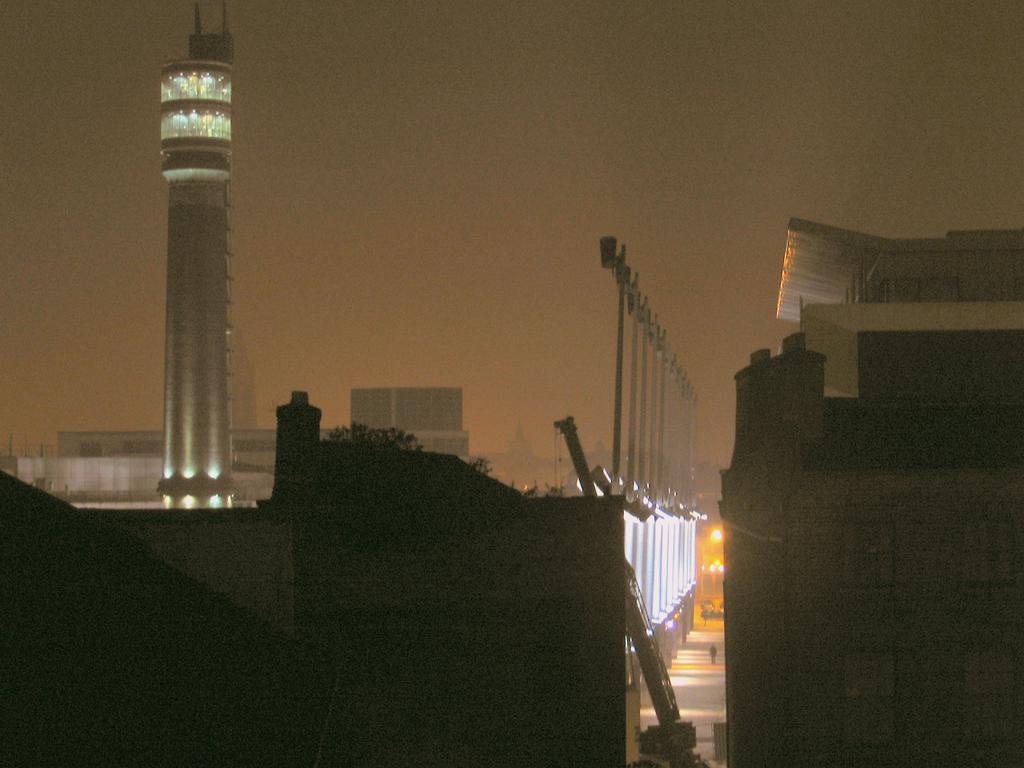
Tuesday, October 18, 2005
Feck Fecking Off BT
I'm a big fan of BT Privacy, the service by which you can stop people in call centres ringing you to sell you stuff. Imagine my surprise, though, when I got cold called by (ta-da!) BT. Apparently this is fine because, according to the poor guy at the end of the phone, BT Privacy doesn't apply to, well, BT.
Now, continue imagining my surprise and add some bemusement. BT have started spamming me. But not in the normal way. No. The first email from them merrily informed me that "At BT we never send out unsolicited emails, so you'll never get any spam from us. To make sure you receive the latest information, special offers and the latest news add our details to your address book." Usually careful me is off to search for the point when I ticked/didn't tick in a way that solicited these emails. If I don't find it I'll just sit in a dark room for a while.
Now, continue imagining my surprise and add some bemusement. BT have started spamming me. But not in the normal way. No. The first email from them merrily informed me that "At BT we never send out unsolicited emails, so you'll never get any spam from us. To make sure you receive the latest information, special offers and the latest news add our details to your address book." Usually careful me is off to search for the point when I ticked/didn't tick in a way that solicited these emails. If I don't find it I'll just sit in a dark room for a while.
Monday, October 17, 2005
China Plug
The sister has posted some fantastic photos from her recent trip to China: take a look here!
Saturday, October 15, 2005
Busy busy busy
 Things here have been enjoyably busy in the last few weeks, which means that posting here has taken a back seat. Not to worry: here's a picture of a flying rat and a Fourth Plinth (strangely for an atheist, my favourite was always Wallinger's Ecce Home).
Wednesday, October 05, 2005
Conservatives Smell the Coffee
I've been fascinated all week by the Tory Party Conference: it's always enjoyable to see the raw sort of democracy in action that takes place (or appears to take place) when the Tories elect a new leader. Seriously: because they're not being too rude to each other they get on with debating issues that they wouldn't dare raise in a parliamentary campaign.
Anyway, Simon Kuper had a very interesting analysis in last Saturday's FT, discussing the state of the party. The basic point of the article is, unsurprisingly, that the Tories have become something of an electoral irrelevance for many of the people they should be attracting (and must attract if they are to be in government ever again). This was explained succinctly to Kuper in a meeting with Nicholas Boles:
Anyway, Simon Kuper had a very interesting analysis in last Saturday's FT, discussing the state of the party. The basic point of the article is, unsurprisingly, that the Tories have become something of an electoral irrelevance for many of the people they should be attracting (and must attract if they are to be in government ever again). This was explained succinctly to Kuper in a meeting with Nicholas Boles:
No more past; no more opportunism; a critic might say that doesn’t leave the Tories with much. They now need a vision of Britain’s future: their own version of “forward not back”.I was also struck by this comment on the last election. Michael Ashcroft has published a report entitled 'Wake Up and Smell the Coffee' (introduction here) based on a series of polls that
Amid the chaos of his desk, Boles has a flipchart showing what is required. His first chart shows the party losing votes among social classes ABC1: professionals, managers, clerks and administrators. In the 1970s the party had a nearly 40-percentage-point lead over Labour among this group. Even as late as 1992, the Tories were still the party of aspiration: Blair once said he knew that year’s election was lost when he met a man out washing his car, who said he’d always voted Labour, but would vote Tory now he had his own business. This May, Boles’s chart shows, the Tory lead over Labour among ABC1 voters was 1 percentage point. “This is our core vote,” he notes. “The Thatcher years were all about blowing away the wets and toffs while self-made people came up. Right now the Tory party represents aspiration only to someone who wants to become a blazer-wearing college-scarved Alan B’stard sort of person, and nobody normal aspires to that.”
Boles flips the page. The next chart shows the party’s support rising among C2s: the skilled working classes, taxi drivers for instance, who like Tory positions on immigrants and crime. Influential Tories are uneasy about attracting these people: as one of them told me, “Our core vote will never be people who own pit bull terriers.”
Then Boles flips the page to the punchline: a graph with a rising line crossing a falling one. It shows the number of ABC1s going up, while C2s die out. The Tories are fishing in a shrinking pool. The change in their voting base evokes Bush’s Republicans: losing the traditional elite, and winning in return poor voters in redneck states who vote Republican against their own economic interests. It’s just that in America, the “faith, flag and family” pitch works better than in Britain.
tracked changes in opinions over several months. These found that although people didn’t like immigration, they weren’t obsessed with it. In the last ICM poll before the election, only nine per cent of voters named it as the key issue. In any case, they didn’t believe politicians could do much about it. Those most worried about immigrants - the working classes and the poorest members of society - were also least likely to vote Tory.What the new leader has to do is not easy. But, as Kuper points out, it is essential. Just as with voters, the lives of political parties do come to an end.
Most Tories now realise that they fought the campaign on a marginal issue.
Roaming
I see the Guardian has published a piece on a European Commission site that reveals the extortionate roaming charges for UK mobile phones across the EU.
Best not to forget one solution to this: if you're going to be in another country for more than a certain amount of time (depending on how much you'll use your phone), get a local SIM card. I for one have an O2 SIM for the Irish Republic and, when I was staying there, had a Belgian SIM: when I cross the border I pop the appropriate one in.
Update: I see that Mick has already mentioned this. Not that that makes my post totally redundant!
Best not to forget one solution to this: if you're going to be in another country for more than a certain amount of time (depending on how much you'll use your phone), get a local SIM card. I for one have an O2 SIM for the Irish Republic and, when I was staying there, had a Belgian SIM: when I cross the border I pop the appropriate one in.
Update: I see that Mick has already mentioned this. Not that that makes my post totally redundant!
Subscribe to:
Posts (Atom)